exploresight

Dog vision simulator

Explore a familiar world through a different pair of eyes. Compare a photo with an approximation of dog vision, shown beside the original.

About this perspective

Compare a photo

About this approximation
Color.
Dogs have two types of cone, most sensitive near 555 and 431 nanometers. Each pixel is converted to linear light and both cone signals are held fixed, then shown on a blue–yellow range: grays and the blue primary stay as they are, and colors that differ mainly between red and green look more alike.
Detail.
Fine detail is softened with a Gaussian blur set so that contrast at the finest detail a dog can resolve falls to 2%, following the micaToolbox Gaussian Acuity Control. The dog value is 12.5 cycles per degree, the midpoint of the 5.5 to 19.5 range measured in bright light for six dogs. In the same study people measured 32.1 to 44.2 cycles per degree, roughly three times higher.
Field of view.
How strong the softening looks depends on how wide a view the picture covers. This tool assumes the picture spans about 60° across its width, like a typical photo. That is an assumption, not a measurement: a closer picture would look blurrier and a wider one less so.
Limits of the method.
The cone peaks come from published fits made with other curve shapes and are used here with one standard pigment template, and the eye’s lens is not modeled. Colors a screen cannot show are clipped.

Understanding dog vision

A different spectrum. Not a black-and-white world.

Dogs have two types of color-sensitive cone; people usually have three. In this model, blue and yellow differences are kept, and colors that differ mainly between red and green look more alike.

Human vision

  • Red
  • Orange
  • Yellow
  • Green
  • Blue
  • Violet

Dog vision · approximation

  • Red
  • Orange
  • Yellow
  • Green
  • Blue
  • Violet

Illustrative color relationships, not measured matches to a dog’s subjective experience.

Try comparing the ball with the grass in the sample above.

Less fine detail.

Dogs generally resolve less fine detail than humans.This preview softens fine detail by one fixed amount and leaves motion unchanged.

Adapted to dimmer light.

A rod-dominated retina and a reflective tapetum are thought to help dogs use dim light.They still need light to see.

A model, not an exact view.

This approximation changes color and softens fine detail by one fixed amount. It does not model low-light vision, movement, depth or field of view, and it cannot show what it is like to be a dog. Dogs differ by breed, age and individual, and the numbers come from small studies. This is not an eye test and says nothing about any dog’s sight.

Further reading

  • Photopigments of dogs and foxes (1993) (no link available)

Method and sources

Each color is converted from sRGB to linear light, reduced to the two dog cone signals, softened, clipped to the range a screen can show, and converted back. The picture is assumed to be an sRGB image on an sRGB display; wide-gamut images can shift slightly.

Sources

The method follows the published sources below, adapted to sRGB screens.

Related discoveries

A little more understanding.

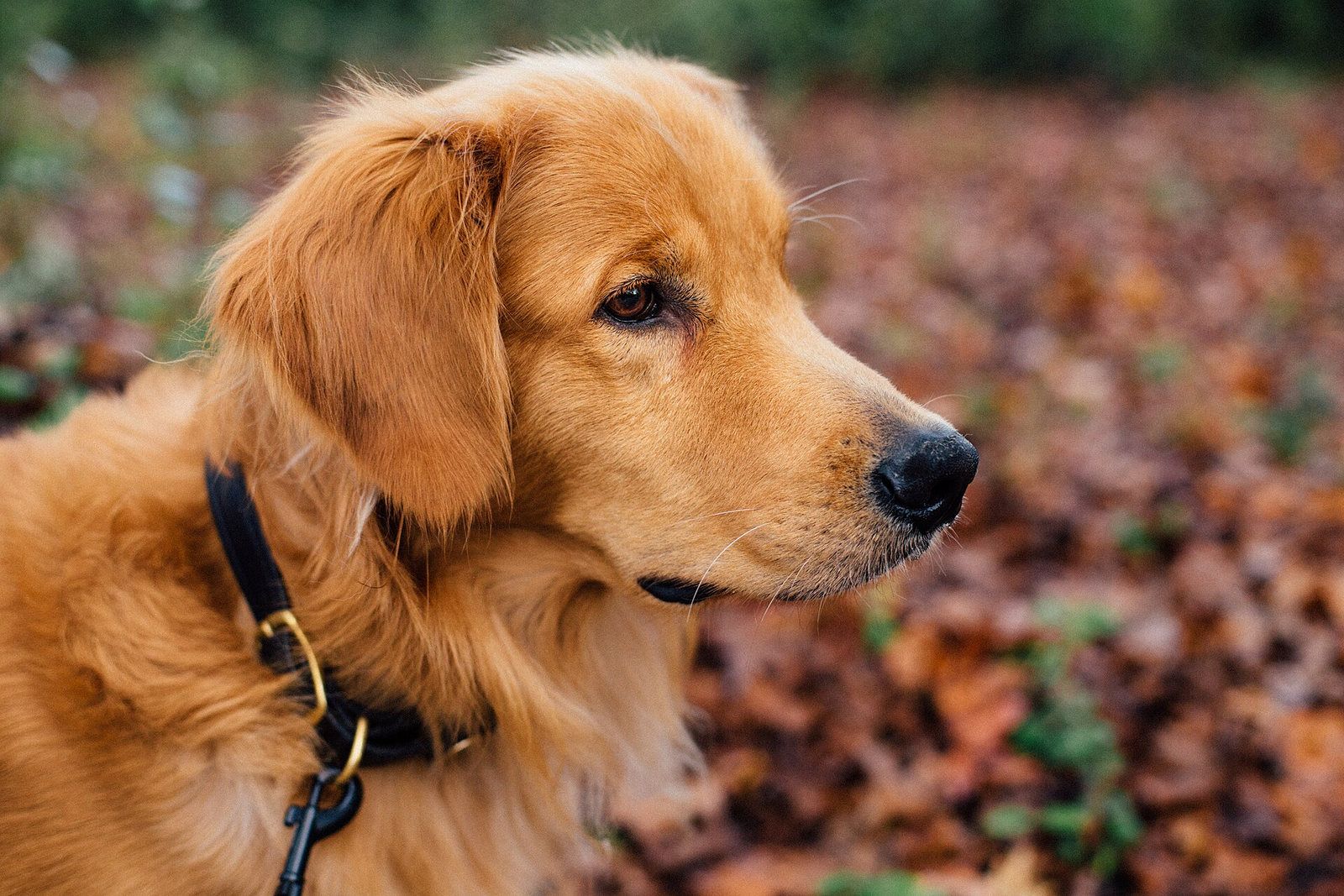
A golden retriever in profile on a ground of brown autumn leaves, looking off to one side.

How different is a dog’s view?

Dogs do see color; the idea that they cannot is a myth. Their color vision is dichromatic, comparable to human red–green color blindness.

This simulator changes color and softens fine detail by one fixed amount. It does not recreate a dog’s field of view, movement or low-light vision.


What colors can dogs see?

Dogs have two types of color-sensitive cones. Blue and yellow differences are easier to distinguish; some reds and greens can look more alike.

Try a red toy on green grass. Red and green can look more alike to a dog, so the toy may be harder to spot by color alone.

Do dogs see the same detail?

Dogs generally resolve less fine detail than humans, but contrast, movement and lighting also affect what they notice. Individual dogs vary, as do age and eye health.

This preview softens fine detail by one fixed amount as well as changing color. It is not an eye test.

Can dogs see in the dark?

A rod-dominated retina and a reflective layer called the tapetum are thought to help dogs make use of dim light. They still need light to see.

This simulator does not model night vision.

  • Sources: Jacobs et al. (1993) (no link available)

Everyday dog vision

Small changes. A clearer world.

A little understanding can change the way you play, explore and share a space with your dog.

  1. 01Playtime

    Choose contrast, not just bright color.

    Red and green can look more alike to a dog, so a red toy on green grass may be harder to pick out. Choose a toy that contrasts with its surroundings.

  2. 02Shared spaces

    Let familiar spaces stay familiar.

    Fine details can be harder to make out, especially at a distance. A consistent layout and clear routes can make everyday spaces easier to navigate.

  3. 03After sunset

    Keep a little light in the picture.

    Dogs have adaptations for dim light, but they still need some light to see. Gentle lighting around steps and doorways can help reveal edges when the light fades.

Every dog is different. Age, eye health and lighting can all affect what they see.

Explore another pair of eyes.

One experience is available now; four more are on the way. Preview the science while they take shape.

Questions about dog vision

Short answers about what this simulator shows, and what it cannot.

What colors can dogs see?

Dogs can see color, but with a different range than most people. They have two types of color-sensitive cone, most sensitive near 555 and 431 nanometers, where people usually have three. Blue and yellow differences are easier to distinguish, and some reds and greens can look more alike.

How does the dog vision filter work?

It changes each pixel of your photo in your browser: both dog cone signals are held fixed to approximate dog color, then fine detail is softened to a dog acuity of 12.5 cycles per degree, the midpoint of the 5.5 to 19.5 range measured in bright light for six dogs. The original stays beside it so you can compare.

How does dog vision compare with human vision?

In the same bright-light study, people measured 32.1 to 44.2 cycles per degree against 5.5 to 19.5 for six dogs, roughly three times higher, so dogs generally resolve less fine detail than people. Color also differs: two cone signals for dogs, usually three for people.

Is this exactly how a dog sees my photo?

No. It is an approximation, not a dog’s exact view. It holds two color signals fixed and softens detail by one fixed amount, using values from studies of a few dogs. It does not model low-light vision, movement, depth or field of view, and dogs differ by breed, age and individual. It is not an eye test.

Keep exploring.

Color perceptionExploration guide

A spectrum of possibilities

Light is only the beginning

Color starts with light reaching the eye. Hues come from combinations of cone signals, and the eye–brain system compares them with the surroundings.

The dog simulator illustrates one species difference. It is not a model of every human color-vision variation.

An experiment you can try now

Place the same blue object against a light background, then a dark one. Its appearance can change with the background, even though the object has not.

Context is part of seeing. A simulated view can invite that observation, but cannot tell you exactly how someone else perceives the world.

Visual conditionsExploration guide

A new kind of understanding

Different changes, different effects

Clarity, contrast, light sensitivity and field of view describe different parts of vision. A person may have difficulty in one area without experiencing the others in the same way.

A blur alone cannot capture the lived experience of a visual condition.

Explore with care

Notice how lighting and contrast influence how easily you find detail. Try a familiar image at a smaller size or with less contrast, and reflect on what becomes harder to identify.

These are learning exercises, not a diagnostic test or an exact recreation. Seek qualified clinical advice for concerns about eyesight.